Close
EvaluA GPS (Evaluate and Apply Health Promotion Guidelines) is a collaborative action-oriented research project. The EvaluA GPS project aims to design a tool (EVALGUÍA) to implement evidence-based guideline recommendations on how to improve community engagement for health and well-being and reduce inequalities (NICE Guideline NG44, adapted to the Spanish context).

EVALGUÍA was co-designed through applied research, combining the best possible evidence in the literature with the experience of implementing and using the tool in 13 projects distributed across Spain. See the publications and the full report to learn more about the design and piloting process.
EvaluA GPS has been funded by the Instituto Carlos III, part of the Ministry of Science and Innovation, and co-financed by the European Union through the European Regional Development Fund, as stated in the Resolution of the Directorate of the Instituto de Salud Carlos III, O.A, M.P., which grants subsidies for Health Research Projects (Health Research Projects modality) of the 2019 call of the Strategic Health Action 2017-2020. The project involves three research institutes: IISA (Aragón), FISABIO (Comunitat Valenciana), and IMIBIC (Andalucía) with projects PI19/01079, PI19/00773, and PI19/01525 respectively; as well as the RICAPPS-RD21/0016/005 group (Chronicity Research Network, Primary Care, and Health Prevention and Promotion) and has been carried out thanks to the networked work of health professionals from seven autonomous communities: Aragón, Andalucía, Catalonia, Comunitat Valenciana, Illes Balears, La Rioja, and Galicia.







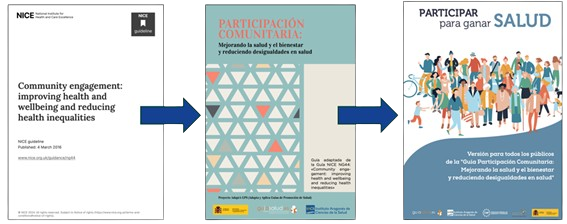
The EvaluA GPS project originates from a previous project, the AdaptA GPS project (“Adapt and Apply Health Promotion Guidelines”), which consisted of adapting the NG44 guideline from the United Kingdom’s National Institute for Health and Care Excellence (NICE) to the Spanish context. This guideline focuses on how to improve community participation based on the evidence. AdaptA GPS was carried out in 2017–2018 and involved a total of 80 people organized into 10 working nodes from 10 autonomous communities: Andalusia, Aragón, Asturias, Catalonia, the Community of Madrid, the Valencian Community, Extremadura, the Balearic Islands, La Rioja and the Region of Murcia.
As a result of this process, since 2018 the new Clinical Practice Guideline on Community Participation has been available in the GuíaSalud Catalogue of the Ministry of Health: “Community Participation: improving health and well-being and reducing health inequalities — AdaptA GPS Project”. In addition to this guideline, a version adapted for citizens was also developed. The project was promoted by the Directorate-General of Public Health of the Generalitat Valenciana, with support from the Community Health Alliance, and received methodological support from GuíaSalud of the Ministry of Health and from the Aragón Institute of Health Sciences. The citizen-version development included collaboration with the Spanish Federation of Municipalities and Provinces (FEMP) and the Spanish Network of Healthy Cities (RECS).
In Aragón, the group responsible for the process was the Aragonese Primary Care Research Group (GAIAP) of the Aragón Institute of Health Research (IIS Aragón), together with the Community Care Strategy in the Aragón Health System —Primary Care—.